


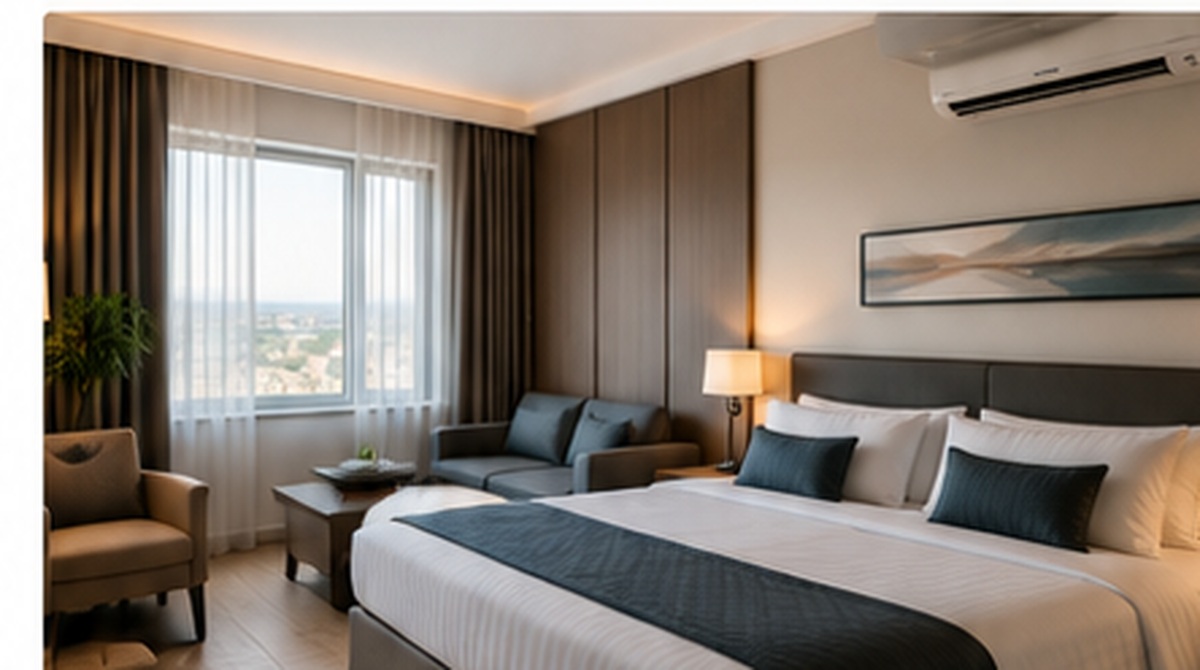
A significant share of a hotel’s electricity consumption comes from heating and cooling systems. In particular, guests leaving the air conditioner running when they leave the room can result in substantial and often unnoticed energy waste in hotels with hundreds of rooms.
For hotel technical managers and energy managers, the main objective is not simply to operate air conditioners more efficiently, but to prevent unnecessary air conditioning without compromising guest comfort.
So, how can hotels prevent air conditioners from running for hours in empty rooms? In this article, we will examine practical hotel air conditioning energy-saving methods and explain how the Klisens K1100 automatic air conditioner shut-off sensor can help solve this problem.
Hidden Energy Waste in Hotel Rooms
A guest may leave the room for breakfast, go to the pool, attend a meeting, take a city tour, or spend the entire day outside the hotel.
However, switching off the air conditioner may not be one of the guest’s priorities.
When the guest leaves the room, the air conditioner may continue operating:
- at a low cooling setpoint such as 18°C or 19°C,
- at high fan speed,
- for several hours.
A few hours of unnecessary operation in a single room may seem insignificant. But in a hotel with 100, 200, or 500 rooms, the same situation occurring every day in dozens of rooms can result in substantial electricity consumption.
And the problem is not limited to guest rooms.
Meeting rooms, administrative offices, staff areas, certain sections of restaurants, and rooms used only periodically can all generate the same type of energy waste when air conditioning continues to operate in unoccupied spaces.
What Is the Real Challenge for Hotel Technical Managers?
The responsibility of a hotel technical manager is not simply to keep air conditioners running.
The real objective is to control energy consumption without compromising guest comfort.
These two objectives can sometimes conflict with each other.
Asking guests to “please remember to switch off the air conditioner” is not a sustainable energy management strategy. Asking housekeeping staff to check the air conditioner in every room also depends heavily on human intervention.
Central building automation systems can be used, but especially in facilities with an existing split air conditioning infrastructure, implementing such systems may require:
- cabling,
- automation infrastructure,
- additional equipment for each room,
- installation,
- system integration.
This leads to a much simpler approach:
Automatically switching off the air conditioner, just as if it had been turned off with its own remote control, when the room is not being used.
What Is Klisens K1100?
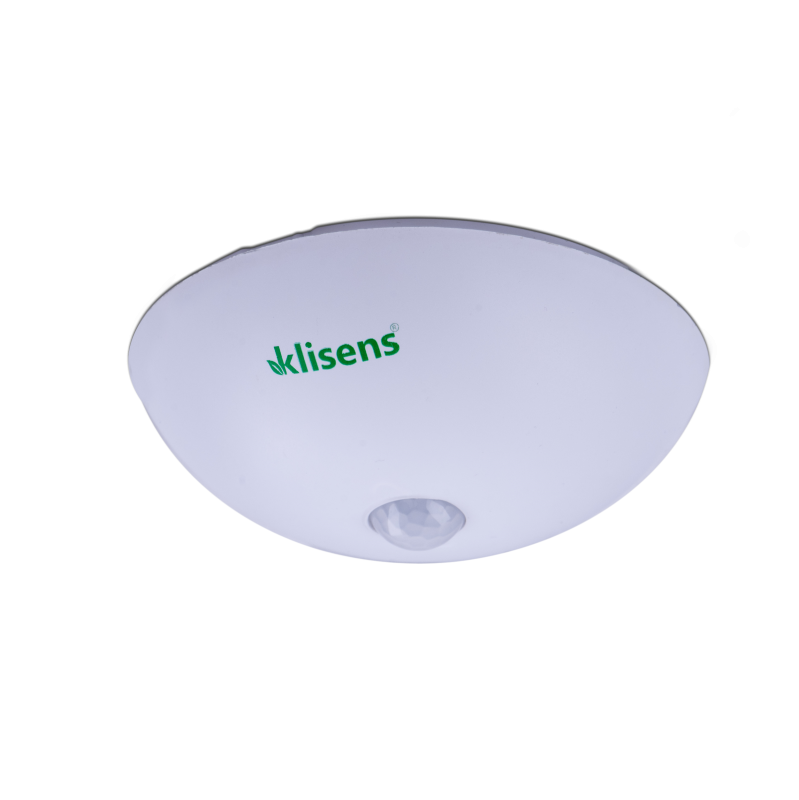
Klisens K1100 is an air conditioner energy-saving and automatic shut-off sensor designed specifically to reduce unnecessary air conditioner operation in hotel rooms and commercial spaces.
The system monitors room usage. If no movement is detected for a predefined period, it sends an infrared OFF command to the air conditioner.
One of its most important advantages is that it does not physically disconnect the air conditioner from the electrical supply. Instead, it operates like the air conditioner’s own remote control. The device is wireless and battery powered.
This feature is particularly valuable for hotels with existing split air conditioning systems.
The Air Conditioner Does Not Need to Be Replaced.
The Existing Electrical Installation Does Not Need to Be Changed.
No New Power Line Is Required in the Room.
No Central Building Automation System Is Required.
K1100 creates an independent control layer that works with the existing air conditioner installation.
How Does the System Work?
Let us consider a simple hotel scenario.
The air conditioner is running while the guest is in the room.
The guest leaves the room to have breakfast but forgets to switch off the air conditioner.
When K1100 detects that the room has not been used for the predefined period, it sends an infrared OFF signal to the air conditioner.
The air conditioner shuts down normally.
When the guest returns to the room, they can switch the air conditioner back on using the existing remote control.
There is one important point:
K1100 does not automatically restart the air conditioner.
This prevents the air conditioner from automatically starting again while the room remains unoccupied.
How Important Is an Air Conditioner Running in an Empty Room?
At hotel scale, small amounts of wasted energy quickly add up.
Hotel technical managers can make an approximate calculation for their own facility using the following simple method:
Monthly unnecessary consumption ≈
Number of unnecessarily running air conditioners × average unnecessary operating time × average air conditioner power consumption × 30 days
The values used in this calculation will be different for every hotel.
The result depends on factors such as whether the air conditioner uses inverter technology, its BTU capacity, outdoor temperature, building insulation, room occupancy rates, and guest behaviour.
For this reason, it would not be accurate to claim a fixed energy-saving percentage for every hotel without first evaluating the individual facility.
However, the basic principle is very clear:
Energy used to cool or heat an empty room provides absolutely no benefit to guest comfort.
The first objective should therefore be to eliminate this unnecessary consumption.
Why Is Occupancy-Based Air Conditioning Control Becoming More Important?
Occupancy-based air conditioning control, where HVAC operation is managed according to whether a room is actually being used, has long been recognised as an important energy-efficiency approach.
A U.S. Department of Energy study on hotel guest-room occupancy controls reported that unnecessary HVAC operation in vacant rooms is an important source of energy consumption and indicated HVAC energy-saving potential of approximately 10–30% for occupancy-based systems. The study also emphasised that actual savings can vary significantly from one facility to another.
In other words, energy efficiency is not only about purchasing a more efficient air conditioner.
Operating the existing air conditioner only when it is actually needed is also an important part of energy efficiency.
Where Can K1100 Be Used?
Hotel guest rooms are undoubtedly one of the strongest application areas for K1100.
However, its use is not limited to hotels.
It can also be considered for:
Hotels and resorts: To control unnecessary air conditioner use during long periods when guests are away from their rooms.
Apart-hotels and rental apartments: To reduce uncontrolled air conditioner usage where electricity costs are paid by the operator.
Offices: For air conditioners left running when employees leave for meetings or field work.
Meeting and training rooms: For areas that are occupied only during certain hours of the day.
Staff rooms and administrative areas: For spaces with irregular occupancy.
Schools, clinics and commercial premises: For rooms equipped with split air conditioners that remain empty for certain periods.
Why Switch Off the Air Conditioner with a Remote Command Instead of Cutting the Power?
When considering air conditioner energy savings, one of the first solutions that may come to mind is completely disconnecting the air conditioner from the power supply using a contactor or card-based energy control system.
However, modern air conditioners are electronically controlled devices.
K1100 takes a different approach.
The device sends an infrared OFF command to the air conditioner, allowing it to shut down in its normal operating manner. In other words, it performs the same type of command as a standard air conditioner remote control.
This is particularly advantageous for retrofit applications in existing facilities.
An Easy-to-Implement Energy-Saving Project for Hotel Technical Teams
One of the challenges of an energy-saving project is that the investment is not limited to the purchase price of the equipment.
If a system requires new cabling, room modifications, automation programming and lengthy installation work, implementation can become difficult and costly.
K1100 is designed to provide a solution while changing as little as possible in the existing air conditioning infrastructure.
For this reason, it is particularly suitable for consideration in retrofit energy-saving projects for existing hotels.
Rather than installing a new system throughout the entire hotel at once, a pilot project is usually the most practical approach.
For example, the technical team can:
- Select a number of rooms with similar characteristics.
- Observe existing air conditioner usage first.
- Install K1100 units in the selected pilot rooms.
- Monitor electricity consumption and guest feedback.
- Expand the application to additional rooms if the results are successful.
This approach allows the technical manager and hotel management to make an investment decision based on real data collected from their own facility.
Can Guest Comfort and Energy Savings Be Achieved Together?
Energy saving should not mean preventing guests from using their air conditioner.
The correct approach is:
Comfort while the guest is in the room, energy savings while the room is empty.
The operating principle of K1100 focuses precisely on this balance.
When the guest is in the room, the existing air conditioner and its remote control continue to operate normally.
When the room remains unused for a long period, unnecessary air conditioner operation is prevented.
This makes the system particularly relevant to the balance between guest comfort and energy management that is so important in hotel operations.
The Next Step in Air Conditioner Energy Savings: Temperature Limiting
Switching off an air conditioner that is running in an empty room addresses one part of the energy-waste problem.
However, there is another issue:
Setting the air conditioner to unnecessarily low or high temperatures while the guest is in the room.
Even if hotel technical management prefers to maintain a particular temperature policy, a standard air conditioner remote control generally allows the user to select almost any available temperature.
This problem requires a different approach from K1100.
Klisens RC1000 was developed for this use case by allowing minimum and maximum air conditioner temperature limits to be defined.
The two products therefore address two different sources of unnecessary energy consumption:
K1100 → Switches off the air conditioner when the room is unoccupied.
RC1000 → Keeps the temperature setting under control while the room is occupied.
Frequently Asked Questions
Can K1100 Damage the Air Conditioner?
K1100 is designed to switch off the air conditioner using an infrared remote-control command instead of directly disconnecting its electrical power.
Does K1100 Require Cabling?
No. The device is wireless and battery powered and communicates with the existing air conditioner via infrared.
Can It Be Used Outside Hotels?
Yes. K1100 can also be considered for offices, meeting rooms, rental properties and other areas equipped with split air conditioners.
How Much Electricity Can It Save?
A single fixed percentage cannot accurately represent every facility. Actual savings depend on air conditioner capacity, operating time, climate, room occupancy and user behaviour.
Studies of occupancy-based HVAC controls in hotel guest rooms have reported potential HVAC energy savings in the range of 10–30%, but the actual result should always be measured separately for each facility.
Conclusion: The Cheapest Energy Is the Energy You Do Not Waste
Improving hotel energy efficiency does not always require replacing the entire air conditioning system.
Sometimes the first step is much simpler:
Do not air-condition a room when nobody is using it.
Klisens K1100 is a practical air conditioner energy-saving solution designed to reduce unnecessary operation in empty spaces without replacing the existing split air conditioning infrastructure.
For hotel technical managers, energy managers, operations managers and facility management teams, K1100 can be considered as a low-intervention energy-efficiency solution that can be applied to existing facilities.